
Our approach to materiality
In 2024, guided by our mission of “creating partnerships that change the world,” we identified six key material issues essential for achieving a sustainable society and enhancing corporate value. By addressing these priorities and meeting the associated goals, we are committed to building a sustainable future.
Strike Group's Materiality
| Strike Group's Materiality | Description | Relevant SDGs |
|---|---|---|
| Contributing to a decarbonized society | We will contribute to the realization of a decarbonized society by reducing greenhouse gas emissions in our business and supporting our clients in transitioning to new business models. |   |
| Providing reliable, client-centric M&A brokerage services across the industry | In delivering M&A brokerage services, our goal is to not only enhance our clients’ corporate value but also to build strong trust by providing accurate information and responding quickly to their needs. Additionally, we are committed to promoting fair, transparent, and responsible business practices across the entire industry. |    |
| Contributing to regional economies by promoting M&A | By facilitating optimal M&A across all regions of Japan, including rural areas, we will promote the revitalization of local economies by ensuring the continuation of essential businesses and increasing the corporate value of our clients. | |
| Resolving local issues through social contribution activities | We contribute to local communities by addressing various challenges through social contribution activities, such as stimulating tourism and exchange, supporting the preservation and transmission of local culture, and actively participating in local initiatives. |   |
| Creating a workplace that unlocks the potential of diverse talent | We respect diversity in terms of gender, age, race, nationality, disability, religion, and values, and create an organization and culture that maximizes each individual’s potential by recognizing, nurturing, and utilizing their unique qualities. |   |
| Ensuring compliance and data security | To ensure that our corporate activities align not only with laws and regulations but also with ethics and social norms, we will implement measures to prevent compliance violations and rigorously manage important information, including client data. | |
Materiality identification process
The following steps were taken to identify material issues:
We identified social issues in the ESG area by referencing GRI, SASB, SDGs, and other international guidelines, along with evaluation criteria from sustainability rating organizations. In addition, taking into account industry-specific issues and our company’s unique circumstances, we identified additional social issues that we should address, resulting in a total list of 51 items.
The 51 social issues identified in Step 1 were comprehensively evaluated from two perspectives: "importance to stakeholders" and "importance to our group." These issues were then organized into a materiality map, narrowing the list down to 12 high-priority social issues.
The 12 social issues identified in Step 2 were organized into six material issues based on the relevance of the initiatives. We confirmed the appropriateness of the six material issues through a series of exchanges of opinions with external experts and internal discussions.
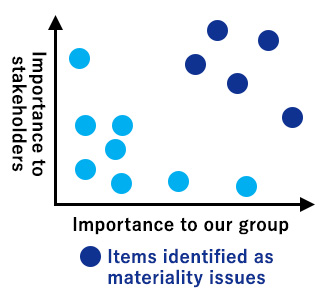
Through the above steps, six material issues were identified as key areas for the Company to address and were subsequently approved by the Board of Directors. We will revise the identified material issues as necessary, in line with the progress of our initiatives and changes in the social and business environment.
KPIs, targets and results
The KPIs and specific targets for achieving each material issue are as follows:
| Materiality | KPI | FY 2025/9 | FY 2026/9 | |
|---|---|---|---|---|
| Targets | Results | Targets | ||
| Contributing to a decarbonized society | GHG emissions (Scope 1+2) reduction rate | 50% reduction by FY2030/9 from the base year (FY2022/9) | Market-based: 34.1% increase | Same as FY2025 |
| Number of M&A transactions closed related to decarbonization and low-carbon businesses | 5 or more cases over 5 years (by FY2029) | 1 case | Same as FY2025 | |
| Providing sound, client-centric M&A brokerage services across the industry | Establish an organizational system based on policies in accordance with industry requirements | Compliance with the M&A Guidelines for SMEs and voluntary regulations of the M&A Advisors Association, and response to the latest trends | Complied with the M&A Guidelines for SMEs, etc. | Same as FY2025 |
| Client satisfaction level | Launch of client satisfaction survey in 2025 | Launched in October 2024 | Expand target and analyze client satisfaction survey (FY2026) | |
| Industry-wide efforts to improve service quality | Active participation, opinion sharing, and promotion of membership in the M&A Advisors Association | Actively participated in the M&A Advisors Association, secretariat meetings, and subcommittees | Same as FY2025 | |
| Number of employee training sessions related to M&A service provision | Company-wide training held at least twice a year (FY2025) | Training for Consultants: 5 sessions (210 minutes in total) | Company-wide training held at least 3 times a year (FY2026) | |
| Contributing to regional economies by promoting M&A | Number of business succession and growth-support M&A deals (seller-side) | Number of deals exceeding the previous fiscal year (FY2025) | 218 deals (FY2024: 204 deals) | Same as FY2025 |
| Number of M&A transactions closed in specific sectors | Cumulative 100 hospital/clinic deals over 5 years (by FY2029) | 22 deals | Same as FY2025 | |
| Resolving local issues through social contribution activities | Clarification of basic policy and approach to social contribution activities | Formulation of policies on social contribution activities | Formulated social contribution activity policy | ― |
| Total amount of company resources allocated to social contribution activities | Dialogue with local communities and enhancement of educational and donation activities contributing to resolving regional issues and development | 2.6 million yen | Same as FY2025 | |
| Creating a workplace that unlocks the potential of diverse talent | Develop a personnel system, training programs, and other frameworks that promote the empowerment and engagement of human resources. | Revamp personnel and compensation systems to drive individual and team growth, provide educational opportunities such as training to foster employee development, and cultivate a corporate culture that encourages challenges | Reviewed the incentive system | Same as FY2025 |
| Education and training costs per employee | At least 100,000 yen per person annually (FY2025) | 170,000 yen per person annually | Same as FY2025 | |
| Number and percentage of employees with qualifications in specific fields | 100% of eligible Consultants acquiring Nissho Bookkeeping Level 2 or equivalent qualifications. (Target: Consultants with at least 1 year of tenure) *Equivalent qualifications: CPA, Tax Accountant, US CPA, SME Management Consultant (FY2025) | 100% | Same as FY2025 | |
| Promotion of diversity and inclusion initiatives | Proactive hiring of seniors, female Consultants, persons with disabilities, and multinational talent | Continued Diversity, Equity, and Inclusion (DE&I) initiatives | Same as FY2025 | |
| Ratio of female managers | 10% (FY2026) | 9.0% | Same as FY2025 | |
| Percentage of male employees taking parental leave | 100% (FY2025) | 54.6% | 90% (FY2026) *Target revised based on deal progress and individual family circumstances |
|
| Percentage of annual paid leave taken | 70% or higher (FY2025) | 71.6% | Same as FY2025 | |
| Ensuring compliance and data security | Reinforcement of compliance promotion systems (review of compliance-related regulations, implementation of compliance training) | Regular implementation of compliance training and review of compliance-related regulations | Established and implemented new sales review regulations. Conducted compliance training. | Same as FY2025 |
| Internal audits related to data security | Maintain a system to properly audit the development and operation of internal controls | Conducted internal audits 3 times a year | Same as FY2025 | |
| Number of information management training and drills conducted | Company-wide training or drills held at least twice a year (FY2025) | Conducted 4 training sessions and 4 email drills | Same as FY2025 | |
