
Fundamental Policy
Under our mission to “Create partnerships that change the world,” we are committed to enhancing corporate value and contributing to the sustainable growth of society through transparent and fair business practices. To strengthen our business execution functions, we have introduced an executive officer system aiming to clearly separate our supervisory and execution roles. In addition, we have established the Nomination and Compensation Advisory Committee and the Audit and Supervisory Committee to strengthen management oversight, thereby ensuring fairness in management. Furthermore, we have built a robust corporate governance system by fortifying our internal control system through measures such as the establishment of the Internal Audit Office and Compliance Promotion Committee.
Corporate governance system (As of December, 2025)
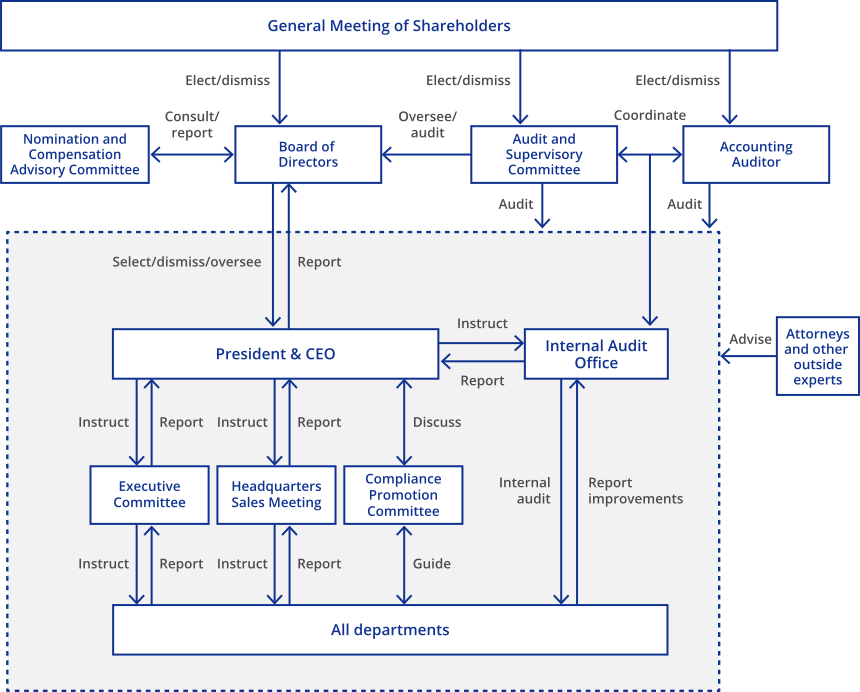
Roles and composition of organizations (As of December, 2025)
1) Board of Directors
The Company’s Board of Directors consists of a total of seven members: three internal directors, and four directors serving as the Audit and Supervisory Committee. All four committee members are independent outside directors, two of whom are women. In addition to the regular monthly meetings of the Board of Directors, extraordinary meetings of the Board are held as necessary to make decisions on the execution of the Company’s business and to supervise the execution of the duties of the directors in accordance with laws, regulations, the Articles of Incorporation, and the Board of Directors Regulations.
The four independent outside directors bring a wealth of expertise from diverse professional backgrounds, including two corporate executives, a certified public accountant, and an attorney. Their contributions offer valuable insights and oversight, aiding the board in managing the company effectively. In the fiscal year ended September 30, 2024, the Board of Directors held 13 meetings, with an average attendance rate of 100%.
2) Nomination and Compensation Advisory Committee
The Nomination and Compensation Advisory Committee has been established as a voluntary advisory body to the Board of Directors. Its primary purpose is to ensure fairness, transparency, and objectivity in the Board’s decision-making process, thereby enhancing our overall corporate governance. Composed of a majority of independent outside directors, this committee focuses on matters concerning the nomination and compensation of directors. It deliberates on these matters in response to consultations from the Board and submits its recommendations. In the fiscal year ended September 30, 2025, the Nomination and Compensation Advisory Committee held five meetings.
3) Audit and Supervisory Committee
The Audit and Supervisory Committee consists of four directors, all of whom are outside directors. The Committee oversees corporate governance and its operation and audits the daily business activities including the execution of duties by the directors. The members of the committee bring diverse professional backgrounds to their roles, comprising two corporate executives, a certified public accountant, and an attorney. Each member leverages their specialized expertise to conduct multifaced audits.
The Committee convenes monthly and holds extraordinary meetings as necessary to formulate audit plans, review the progress of ongoing audits, discuss audit results, and other related matters, and facilitate the exchange of information among its members. The Committee met 12 times during the fiscal year ended September 30, 2025.
4) Executive Committee
The Executive Committee, which consists of full-time internal directors, meets as needed to report on the status of business execution and to deliberate on critical issues, operational matters, and future development strategy, among other relevant topics. The Committee met 16 times during the fiscal year ended September 30, 2025.
5) Headquarters Sales Meeting
Directors, executive officers, and general managers of sales-related departments meet at least monthly at the Headquarters Sales Meeting to accelerate decision-making and improve the efficiency of business execution by discussing the progress of deals, the status of contract acquisition, and day-to-day operational challenges.
6) Compliance Promotion Committee
The Company established a Compliance Promotion Committee to foster a strong culture of compliance and drive related initiatives from a company-wide perspective. Chaired by a full-time director, this seven-member Committee meets monthly to discuss and promote compliance initiatives.
7) Internal Audit Office
The Company has set up an Internal Audit Office that reports directly to the President. This office conducts audits focused on compliance with laws, regulations, and internal rules, as well as on preventing misconduct and enhancing operational efficiency and management effectiveness. Audit findings are regularly reported to both the President and the Audit and Supervisory Committee. Should any significant issues arise, the Internal Audit Office not only reports these issues to the President and the Committee but also follows up to ensure that appropriate corrective actions are implemented.
8) Accounting Auditor
We have engaged KPMG AZSA LLC as our independent accounting auditor to conduct our external audits.
Corporate Governance Report
Executive compensation
Basic approach to determining compensation
- The compensation system is rooted in the realization of the Company’s corporate philosophy.
- The compensation system is designed to reflect the Company’s management policy and medium-term management plan, incentivizing the enhancement of the corporate value over the medium to long term while mitigating short-term orientation.
- The level and structure of compensation are effective in securing the outstanding talent needed to lead the Company into the future. They also reflect the roles and responsibilities of each director.
- Procedures for determining compensation are transparent, fair, and objective to ensure accountability to all stakeholders, including shareholders, investors, and employees.
Compensation is determined by resolution of the Board of Directors, within remuneration limits approved at the General Meeting of Shareholders, following consultation with the Nomination and Compensation Advisory Committee, which is composed of a majority of independent outside directors.
Detailed policies and procedures for determining compensation are disclosed in the annual securities report.
Compensation structure
In addition to base remuneration, the Company offers performance-based compensation to its directors (excluding Audit and Supervisory Committee members) to clarify their accountability for business outcomes.
Performance-based compensation is tied to the Company’s operating profit and the degree to which the operating profit target for each fiscal year is achieved. This approach aims to drive business expansion and ensure the realization of yearly profit targets. The amount of operating profit figure used in this calculation is the amount prior to deduction of performance-based compensation. Based on a predefined formula for calculating the maximum payout, the specific performance-based compensation each director receives is determined by a resolution of the Board of Directors, taking into consideration each director’s contribution to the Company’s performance, the overall cap on director remuneration, and other relevant factors.
Maximum amount of performance-based compensation = operating profit x performance coefficient* + increase in operating profit from the previous fiscal year x 5%
*Performance coefficient
(1) If operating profit exceeds the initial target: 1.5%
(2) If operating profit falls below 90% of the initial target: 0%
(3) If operating profit is between 90% and 100% of the initial target: 1.5% x (achievement rate - 90%) / (100% - 90%)
Note: The above operating profit used in the above calculation is the operating profit before the deduction of performance-based compensation
Process for determining compensation
The base remuneration for each director is set by the Board of Directors, based on recommendations from the Nomination and Compensation Advisory Committee. Serving as a voluntary advisory body to the Board, the committee evaluates factors such as each director’s specific role, responsibilities, and scope of duties when formulating its recommendations. Performance-based compensation is similarly determined by a resolution of the Board of Directors, following recommendations submitted by the Nomination and Compensation Advisory Committee.
Compensation paid
Compensation paid in FY2025/9
| Category | Total amount of compensation, etc. (Thousand yen) | Total amount of compensation, etc. by type (Thousand yen) | Number of eligible officers | ||
|---|---|---|---|---|---|
| Base pay | Performance-based compensation | Non-monetary compensation, etc. | |||
| Directors (excluding Audit and Supervisory Committee members and outside directors) | 228,000 | 228,000 | — | — | 4 |
| Outside directors (excluding Audit and Supervisory Committee members) | 5,400 | 5,400 | — | — | 3 |
| Outside directors (Audit and Supervisory Committee members) | 25,800 | 25,800 | — | — | 4 |
Note: At the 29th Ordinary General Meeting of Shareholders held on December 23, 2025, the Company's directors were re-elected, resulting in a decrease of one director (excluding Audit and Supervisory Committee members and outside directors) and one outside director (excluding Audit and Supervisory Committee members).
Assessment of the Board’s effectiveness
To enhance board functionality, the Company conducts an annual assessment of the effectiveness of the Board of Directors as part of our ongoing efforts to strengthen corporate governance. Regarding the fiscal year ended September 2025, we administrated a survey to all Directors in November 2025 through an independent third-party organization to analyze and evaluate the Board’s effectiveness. Responses were submitted directly to the independent third-party organization to ensure anonymity.
Basic assessment process
| STEP 1 | STEP 2 | STEP 3 |
|---|---|---|
| Distribution of a questionnaire for all Board members | Compilation and analysis of questionnaire results by an independent third-party organization | Identification of key issues to be addressed |
Assessment results and efforts to address issues identified
FY2025/9
| Initiatives in FY2025/9 | FY2025/9 effectiveness assessment | Direction of initiatives in FY2026/9 | |
|---|---|---|---|
| Survey administration | Analysis and issue identification | ||
|
Administrated a survey to all Directors Evaluation method Anonymous survey Questions
Compilation of survey results Compiled and summarized by a specialized third-party organization. |
Third-party compilation and analysis of survey results Overall assessment
Issues identified
|
|
FY2025/9 Initiatives Based on FY2024/9 Survey Results
- Hosted reporting sessions where executive officers and department heads briefed outside directors on departmental operations and challenges.
- Organized study sessions and briefings for outside directors regarding the transition to a holding company structure.
- Improved the comprehensiveness of meeting materials and distributed them further in advance of meetings.
- Reported the details of investor meetings and investor feedback to the Board of Directors on a quarterly basis.
Internal Control System
The Company’s Board of Directors has established a Basic Policy on Internal Control Systems, which the Company is actively maintaining and operating. This policy is reviewed and updated as necessary to adapt to changing circumstances. An overview of the Basic Policy is as follows:
1. Basic policy on internal control systems and status of development
The Company’s Board of Directors has adopted a basic policy on internal control systems, which the Company is actively developing and implementing. This basic policy will be periodically reviewed and adjusted as needed to adapt to environmental changes. The outline of the basic policy is as follows:
1) System for ensuring that the execution of duties by directors and employees complies with laws, regulations, and the Articles of Incorporation
- The Company instills corporate ethics to ensure strict adherence to laws, regulations, and the Articles of Incorporation, while also meeting societal expectations. The Compliance Promotion Committee takes a central role in ensuring all employees understand and comply with these standards.
- If a director identifies a serious violation of laws, regulations, or internal policies, they must immediately report it to the Board of Directors. If necessary, a Risk Management Committee is established to address the issue. The Company will also collaborates with external experts to handle these violations effectively.
- The Company maintains a whistleblowing system as a mechanism to prevent violations of laws, regulations, and the Articles of Incorporation.
- The Internal Audit Office, reporting directly to the President, conducts audits and reports on the status of compliance to the President, the Audit and Supervisory Committee and the department in charge of compliance.
- The Company develops and disseminates policies on crucial issues such as combating anti-social forces and corruption, ensuring all employees are knowledgeable about these mandates.
2) System for the storage and management of information related to the execution of directors’ duties
- The Company establishes guidelines for the storage and management of documents to ensure that internal information is appropriately stored and managed.
- Regarding information system security, the Company formulates rules for the management and operation of its information systems and ensures the secure management of electronic information in accordance with these rules.
3) Regulations and other systems for managing the risk of loss
- The Company establishes and enforces risk management rules aimed at quickly identifying risks. Additionally, a system is in place to consolidate risk information and report it directly to the President, ensuring a swift and effective organizational response.
- The Company also consults with law firms and other experts as needed and maintains strong relationships with them to address risks promptly and effectively.
4) System for ensuring the efficient execution of duties by directors
- The Company implements and maintains a system that facilitates business operations based on clearly defined divisions of duties and authority within its internal rules to enhance the efficiency of business execution.
5) System to ensure the appropriateness of operations of the corporate group consisting of the Company and its subsidiaries
- The Company establishes regulations for overseeing its subsidiaries. These rules require subsidiaries to regularly report on their operational execution and business conditions.
6) System regarding directors and employees to assist the Audit and Supervisory Committee in its duties, matters regarding the independence of such directors and employees, and matters regarding the effectiveness of instructions given to such directors and employees.
- The Company, in consultation with the Audit and Supervisory Committee, appoints a director or employee to assist the Audit and Supervisory Committee in its duties.
- When an employee is designated to assist the Committee in its duties, the authority to direct, supervise and evaluate this employee’s performance within the scope of such duties is strictly transferred to the Audit and Supervisory Committee.
7) System for directors (excluding directors who are members of the Audit and Supervisory Committee) and employees to report to the Audit and Supervisory Committee, and other systems related to reporting to the Audit and to Supervisory Committee
- The Board of Directors convenes monthly and directors (excluding directors who are members of the Audit and Supervisory Committee) report on important matters. In addition, directors (excluding directors who are members of the Audit and Supervisory Committee), and employees report on the status of execution of their duties, and other relevant matters whenever requested by the members of the Audit and Supervisory Committee selected by the Audit and Supervisory Committee. Furthermore, members of the Audit and Supervisory Committee hold regular meetings to exchange opinions with the President and receive detailed reports on business performance and other matters from the officer in charge of the Administration Department on a regular basis.
- The contact point for the whistleblowing system is an independent third party outside the Company, and strict measures are taken to ensure that whistleblowers are not identified. All reports received through this system are directed to the Audit and Supervisory Committee. Furthermore, the Committee may request explanations from the directors (excluding directors who are members of the Audit and Supervisory Committee) regarding reasons for any transfers, personnel evaluations, disciplinary actions, or any other administrative measures concerning the reporters.
8) Matters relating to expenses or liabilities incurred in the execution of duties by members of the Audit and Supervisory Committee (limited to those relating to the execution of duties by the Audit and Supervisory Committee)
- The Audit and Supervisory Committee has the authority to request an annual budget from the Company for its operational needs. Should this budget prove insufficient for carrying out their duties effectively, the Committee may request additional funds. The Company promptly fulfills these requests unless there is a valid reason for denial, such as if the requested items are clearly not pertinent to the responsibilities of the Audit and Supervisory Committee members.
9) Other systems to ensure the effectiveness of audits by the Audit and Supervisory Committee
- Directors (excluding those who are members of the Audit and Supervisory Committee) actively collaborate with the Audit and Supervisory Committee to foster and enhance the auditing environment within the Company.
- The Audit and Supervisory Committee has the authority to request cooperation from the Administration Department and other relevant departments to assist in conducting audits as needed.
Internal audit system
The Company has established an Internal Audit Office that reports directly to the President. This office conducts audits focusing on compliance with laws, regulations, and internal rules, as well as on preventing misconduct and enhancing operational efficiency and management effectiveness. Audit findings are regularly reported to the President and the Audit and Supervisory Committee. Should any significant issues arise, the Internal Audit Office not only reports these issues to the President and the Committee but also follows up to ensure that appropriate corrective actions are implemented.
